
There is a peculiar irony embedded in how researchers and data practitioners have long approached statistical software. Tools that were designed to ease the burden of quantitative analysis have, over time, accumulated so many legacy conventions that operating them has become an expertise unto itself — separate from, and sometimes at odds with, the actual business of understanding data.
The question worth asking in 2026 is not "which software do I know?" but rather: "which environment most honestly serves my data and the conclusions I need to draw from it?"
The Automation Gap in Statistical Practice
Most practitioners working with parametric tests operate under an implicit two-step assumption: first, choose your test; second, run it. What this model elides is the critical gatekeeping step — verifying that the assumptions underlying the chosen test are actually met by the data in front of you.
Normality testing, in particular, tends to be treated as an afterthought. One researcher runs a Shapiro-Wilk test manually, adds the result to their notes, then either proceeds with the parametric analysis regardless, or pivots to a non-parametric equivalent through a separate, disconnected workflow. This is not a failure of individual diligence; it is a structural failure of the tools themselves.
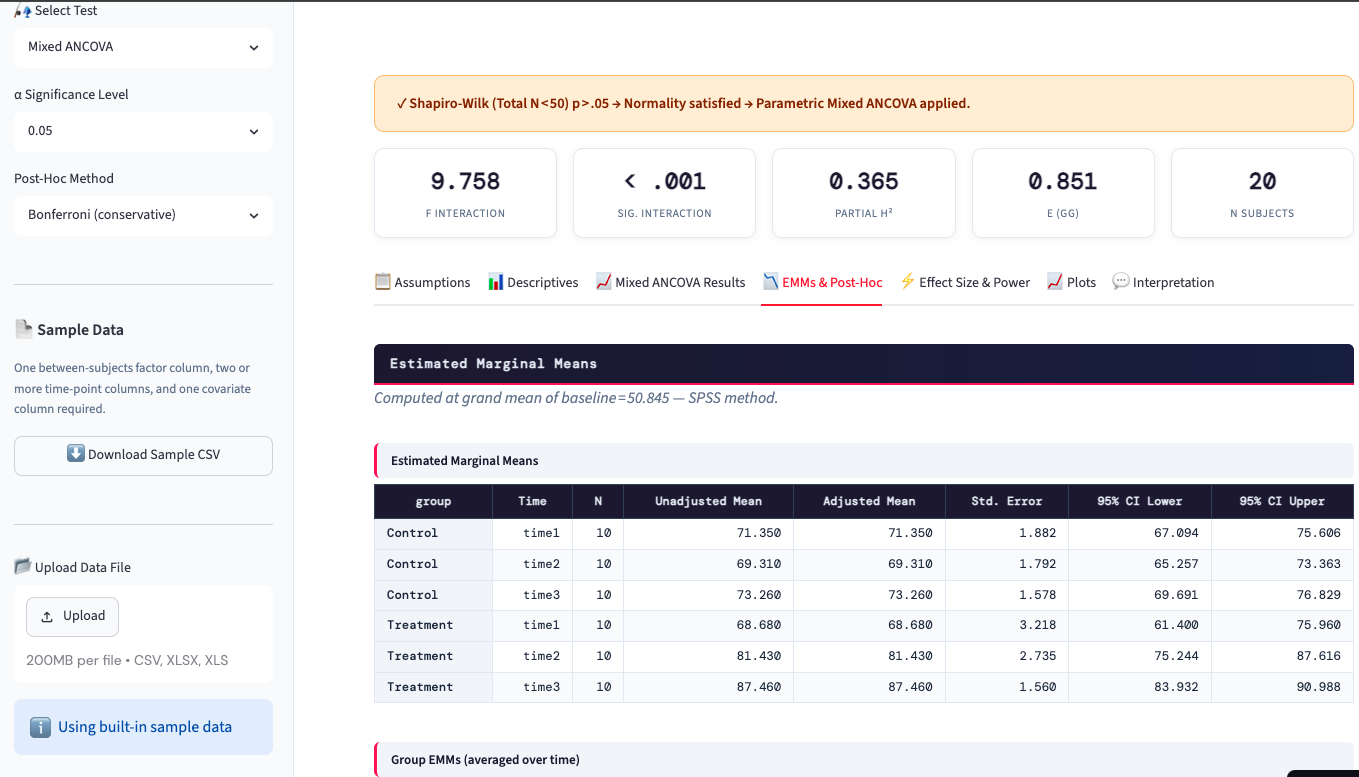
What a Modern Statistical App Actually Covers
A well-designed statistical platform for the contemporary researcher should handle the full scope of common parametric analyses without forcing the user to migrate between environments. Consider the landscape of tests a working analyst regularly encounters:
One-Sample T-Test
Compare one group mean to a known value.
Paired Sample T-Test
AI-based service that does qualitative coding.
Independent Sample T-Test
Compare means from two independent groups.
One-Way ANOVA
Compare means across three or more independent groups.
Factorial ANOVA
Examine main effects and interactions of two or more factors.
Repeated Measures ANOVA
Test changes across three or more time points in the same participants.
Mixed ANOVA
Test between-subjects and within-subjects effects simultaneously.
One-Way ANCOVA
Compare group means while controlling for a covariate.
Factorial ANCOVA
Test factorial effects while controlling for covariates.
Repeated Measures ANCOVA
Compare repeated measurements while controlling for a covariate.
Mixed ANCOVA
Between × within design with covariate control.
MANCOVA
Multiple dependent variables simultaneously, controlling for a covariate.
Simple Linear Regression
Model the linear relationship between one predictor and one outcome.
Multiple Regression
Model the simultaneous effects of multiple predictors on one outcome.
Bivariate Correlation
Measure the strength and direction of association between variables.
Reliability Analysis
Assess internal consistency reliability of one or more constructs.
That is a substantial portfolio. And each of these methods carries its own constellation of assumptions — about distribution shape, variance homogeneity, independence of observations, and linearity of relationships. Handling this portfolio manually, test by test, assumption by assumption, is not just inefficient. It is a persistent source of methodological vulnerability.
The Normality Problem — and Its Automatic Solution
Perhaps no assumption is more frequently violated — or more frequently ignored — than normality. For every parametric test that relies on this assumption, a corresponding non-parametric alternative exists. The Mann-Whitney U stands in for the independent samples t-test. The Wilcoxon signed-rank test mirrors the paired t-test. The Kruskal-Wallis H-test parallels the one-way ANOVA.
An intelligently constructed platform does not ask you to know this mapping in advance. It computes both the parametric and the non-parametric results simultaneously, evaluates the normality of your data using established criteria, and — critically — recommends which set of results you should actually report and why. This is not hand-holding; it is methodological accountability built into the architecture of the tool itself.
Automatic Assumption Checking
Normality evaluated per variable, per group — before results are presented, not after.
Parametric + Non-Parametric
Both computed in parallel. The recommended test is flagged clearly with contextual reasoning.
Automatically-generated Descriptive Interpretation
Results are translated into plain-language narrative — not just a table of numbers.
Full Parametric Coverage
On Interpretation: The Final Mile That Software Usually Skips
Statistical output is, at its core, an intermediate product. The terminal deliverable is interpretation — a meaningful account of what the numbers actually say about the phenomenon under study. Yet most statistical environments stop at the table. They give you F-values, p-values, partial eta-squared, and confidence intervals, and then leave you to translate these into coherent analytical prose on your own.
This translation step is where errors propagate most readily. A researcher who misreads the direction of a significant interaction, or who misattributes the source of variance in a factorial design, does not make that mistake in the computation — they make it in the narration. A platform that provides automated descriptive interpretation alongside its numerical output is not replacing the researcher's judgment; it is scaffolding it, providing a starting point for narrative that the analyst can refine, extend, or interrogate.
Regression and Correlation: Precision Without Overhead
In regression analysis — whether simple linear or multiple — the interpretive demands are particularly acute. Researchers must navigate coefficient tables, assess model fit, evaluate multicollinearity in multiple regression contexts, and communicate effect sizes in terms that non-specialist audiences can follow. Each of these tasks benefits from automation not as a substitute for understanding, but as an accelerant for it.
Bivariate correlation similarly demands attention to the distinction between statistical significance and practical magnitude. A platform that contextualizes r-values within a framework of effect size conventions — and that automatically flags when correlation structures suggest curvilinearity or outlier influence — is a platform that functions as an analytical collaborator rather than merely a computational engine.
Reliability Analysis and the Integrity of Measurement
For researchers working with scales, questionnaires, or composite measures, reliability analysis is foundational. Cronbach's alpha, inter-item correlations, and item-total statistics tell the story of whether a measurement instrument is coherent and internally consistent. This analysis, too, should live in the same environment as the inferential tests that follow — not in a separate workflow, not in a different software license, and not buried under menus that require specialist navigation.
The continuity between reliability analysis and the downstream parametric tests that use the resulting composite scores matters for research integrity. When the entire analytical pipeline is visible in a single environment, the chain of evidence from raw item scores to final inferential conclusions becomes auditable, reproducible, and defensible.
The Case for Switching — Without Naming Names
If you have used institutional statistical software for any length of time, you likely recognize the following experience: a small, seemingly simple analysis — say, adding a covariate to an existing ANOVA design to run an ANCOVA — suddenly requires navigating a different dialog, re-specifying your variables from scratch, and manually cross-referencing the output with your earlier analysis to piece together a coherent picture. The tool's architecture was not designed around your workflow; you are expected to adapt your workflow to the tool's architecture.
The reversal of this relationship — designing the tool around the researcher's actual analytical process — is not a cosmetic upgrade. It is a philosophical reorientation. And it produces measurably different outcomes: fewer errors at the assumption-checking stage, more consistent interpretation of results, and substantially less time spent on the mechanical overhead of analysis.
A Final Word on Transparency
There is a legitimate concern, occasionally raised, that automation in statistical analysis risks producing researchers who do not understand what they are running. This concern deserves to be taken seriously — and it is best addressed not by preserving unnecessary friction, but by designing automation that is transparent about its logic. When a platform tells you "your data fails the normality assumption; here is the non-parametric alternative and here is why it is preferred in this case," it is teaching as well as computing. The output is simultaneously a result and an explanation.
The goal, ultimately, is a practice of statistical analysis that is more rigorous, more efficient, and more honest — about what the data shows, about the assumptions the analysis requires, and about the limitations that remain. The right tool does not lower the bar. It raises it, by making the bar visible in the first place.
